Body Dosent Care if It Ever Moves Again Tired
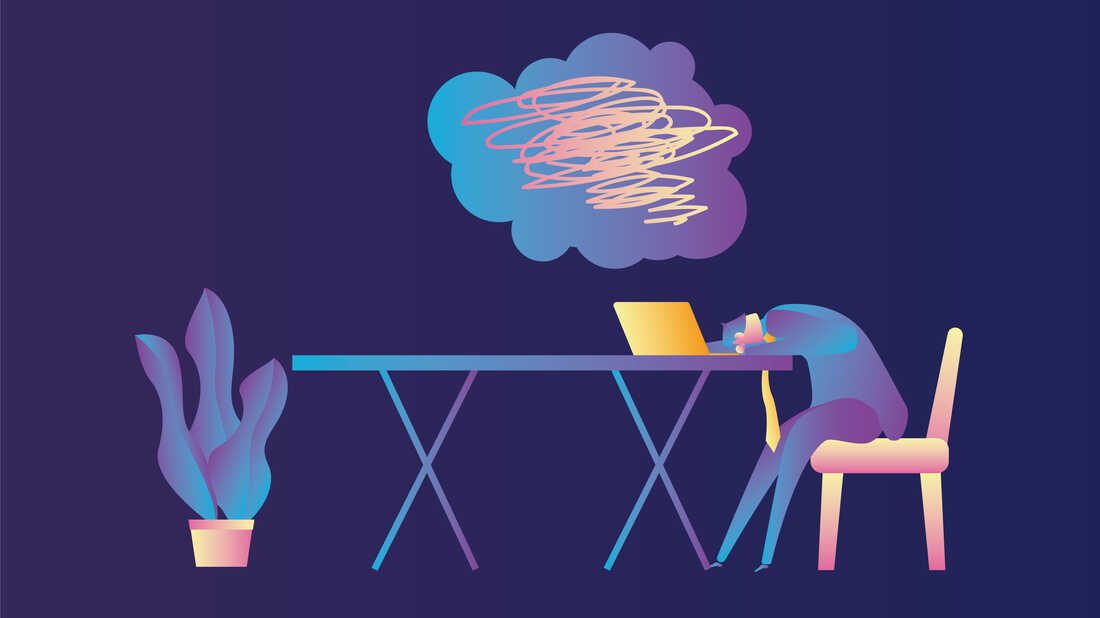
Feelings of exhaustion, irritability and mental fogginess are our bodies' normal response to an abnormal year of pandemic life. Wenjin Chen/Getty Images hibernate explanation
toggle caption
Wenjin Chen/Getty Images
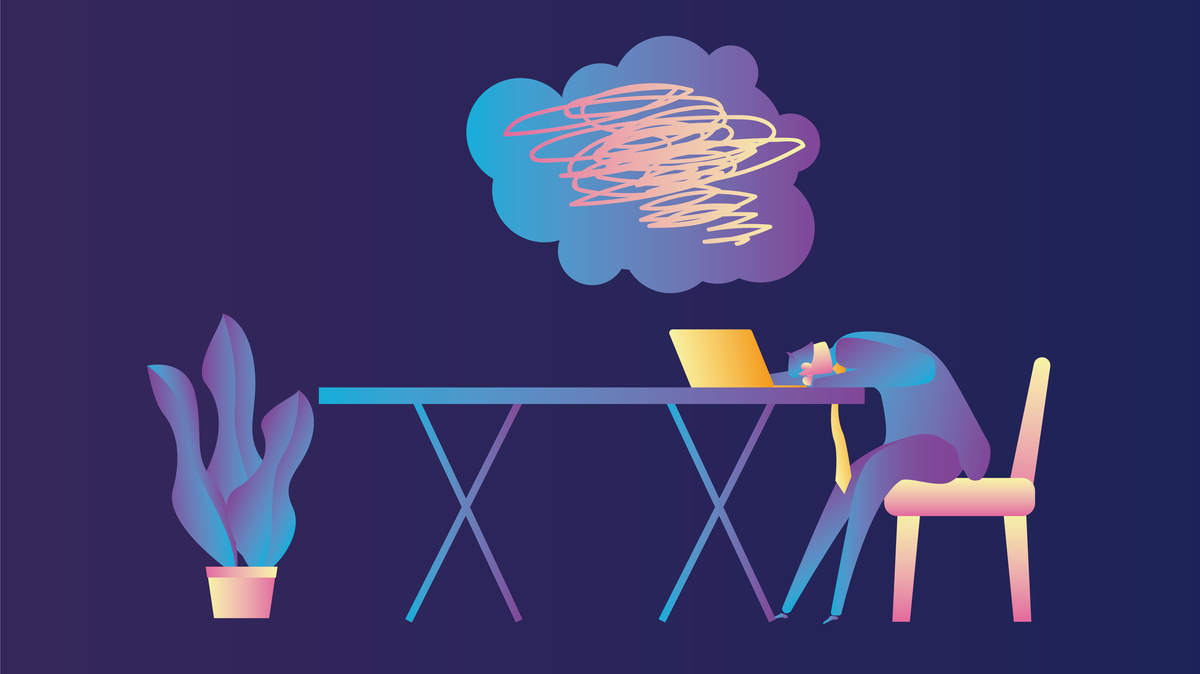
Feelings of burnout, irritability and mental fogginess are our bodies' normal response to an abnormal year of pandemic life.
Wenjin Chen/Getty Images
In recent weeks, Dr. Kali Cyrus has struggled with periods of burnout.
"I am taking a nap in between patients," says Cyrus, a psychiatrist at Johns Hopkins University. "I'm going to bed earlier. Information technology's difficult to even merely get out of bed. I don't feel like being active again."
Exhaustion is also 1 of the top complaints she hears from her patients these days. They say things like, "It'southward merely and so hard to get out of bed" or "I've been misplacing things more often," she says.
Some patients tell Cyrus they've been making mistakes at work. Some tell her they can "barely plow on the Boob tube. 'All I desire to practise is stare at the ceiling.' " Others say they are more irritable.
While some people who have had COVID-nineteen study brain fog and fatigue equally lingering symptoms of their infection — what'southward known as long COVID — mental health intendance providers around the U.S. are hearing similar complaints from people who weren't infected by the virus. And many providers, like Cyrus, are feeling information technology themselves.
This kind of mental fog is existent and tin can have a few different causes. But at the root of information technology are the stress and trauma of the past year, say Cyrus and other mental health experts. It's a normal reaction to a very abnormal year.
And while many people volition probable continue to struggle with mental health symptoms in the long run, research on past mass traumas suggests that nearly people will recover in one case the coronavirus pandemic ends.
"We know that the bulk of people tend to be resilient," says Lynn Bufka, a psychologist with the American Psychological Association. "They may have struggled during the time of the challenges but generally come out OK on the other end."
In the concurrently, Bufka and other experts say that there are things we can do now to fight the mental fog and burnout.
How stress and sleep are linked
"Exhaustion can be a symptom of many things," says Cyrus.
For one, information technology can exist a symptom of stress.
"We know from other inquiry that people will talk about fatigue as something that they feel when they're feeling overstressed," says Bufka.
A recent survey by the American Psychological Clan found that 3 in 4 Americans said that the pandemic is a meaning source of stress.
Millions of people have lost loved ones, have become sick themselves and/or accept lost income as a result of the pandemic. The threat of COVID-19 alone has been stressful for about people, every bit has all of the upheaval that the pandemic has brought, says Bufka.
Stress "keeps our mind vigilant and our nervous organisation vigilant, and that uses more energy," says Elissa Epel, a psychologist at the University of California, San Francisco. That's i reason that prolonged stress can exit us feeling drained.
Another mode that chronic stress makes the states feel exhausted is by interfering with slumber, says Bufka. "When we're feeling stressed, our sleep tin get disrupted, which naturally leads to feelings of tiredness and exhaustion," she says.
"We actually rely on sleep to recover each twenty-four hours," explains Epel. "And and then for many of u.s., fifty-fifty though we might call up we're sleeping the aforementioned number of hours, information technology's not the same quality. It doesn't accept the same restorative ability, because we're getting less deep sleep, and we call up that is tied to this chronic, subtle uncertainty, stress."
Chronic stress also triggers low-form inflammation, she adds.
"We have this inflammatory response when we're feeling severe states of stress that can final. It's subtle, information technology'due south low form and information technology can absolutely cause fatigue and a worse mood."
A year of anxiety, grief and trauma
The fatigue and fog so many are feeling at present too could exist symptoms of other mental health issues that flared over the last year, says Dr. Jessica Gilt, a psychiatrist at Washington Academy in St. Louis. "After this long, most people have had some caste of anxiety, depression, trauma, something," she says.
Equally studies have shown, rates of feet and depression in the population have gone up during the course of the pandemic.
Long-term anxiety can also exhaust the body, says Gilded.
"We evolved as creatures, people that run from predators in the animal kingdom, correct? To have anxiety as a way to predict and run from threat," she says.
When we're anxious, our hearts race and our muscles tense up every bit nosotros prepare to fight a predator or run from it. Only "you lot can only run a 100-g dash for a short amount of time. Not a year, and not a year where they keep moving the finish line," says Golden. "Nosotros can't exercise that. Eventually our muscles and our body say, 'No, I'thousand tired.' "
The rise in symptoms of anxiety and low, which include exhaustion, is a predictable response to the trauma of the pandemic, says Dr. Sandro Galea, dean of the Schoolhouse of Public Health at Boston Academy.
"The definition of a trauma is an result that threatens people's sense of safe and stability," which this pandemic is, he adds.
Almost all of us are grieving the loss of life as we knew it, says Dr. Jennifer Payne, director of the Women's Mood Disorders Center at Johns Hopkins. "We're only in a completely dissimilar earth right now," she says. "A lot of things are non going to go dorsum to the way they were. And and then that causes grief and is a normal reaction to a large change."
Withal, the trauma is much bigger for individuals directly afflicted by the pandemic, says Galea. That includes those who've lost loved ones, lost a chore or housing, struggled with child care, or have had COVID-19 themselves — some of whom report continuing to experience burnout that'southward thought to be associated with the viral infection.
Some people have been hit and so hard — and are so worn down — that "they are having problem coming dorsum from this," says Cyrus, the Johns Hopkins psychiatrist, whose patients are generally people of color and/or queer. Blackness and Latino communities in particular have been disproportionately afflicted by the pandemic and its fallout.
And people in these communities will probable struggle with more mental and concrete wellness problems in the long run, notes Galea, and demand access to mental health care and greater support to recover.
Steps to take now
For many people, the relaxing social activities that can assistance buffer against stress and anxiety — like seeing friends or going out to dinner — are not nevertheless reality, due to uneven vaccination rates. So what tin we practise at present to help recharge?
Payne, of Johns Hopkins' Women'southward Mood Disorders Heart, encourages people to keep in mind all of the usual things that help during stressful times: exercise, a healthy diet, going outdoors and limiting news consumption. And engage in relaxing activities often, like a hobby you love, listening to or watching something funny, or reading books you enjoy.
If these diversions aren't working for you now, she recommends trying a modify of scenery if you tin.
For Payne, who lives in Baltimore, that meant staying at her parents' home in Westward Virginia for 3 nights.
"It was not a very heady trip, but nosotros got away and it was a completely dissimilar environment. And I didn't have whatsoever projects around the house that I could practise other than reading or listening to a podcast, sleeping, eating," Payne says. "And that was really, actually renewing for me."
Nonetheless, Cyrus, who is also at Johns Hopkins, says some of her patients say their normal coping strategies aren't working.
That's considering we are running on an emptier gas tank than usual, she says. "Your coping strategies that might be able to refill you a certain per centum, [but at present] you're starting lower. So it'southward not quite getting you where you demand to exist."
If that's the instance for you lot, try changing upwardly your routine, Payne says. "If y'all're walking every day and that's no longer helping, you try biking."
Cocky-care is important, notes Gilded of Washington University. "Have the vacation time you need," she recommends. "Make certain that y'all're taking care of yourself in the short and long term."
And, she adds, "there's no wrong fourth dimension to become talk to someone." If you tin can't get an appointment with a therapist, talk to a friend or co-worker, she suggests.
"I remember that considering so many people are struggling with this and considering it is then normal, everybody has something to say," says Gold. "If we could just get to the point where we could be talking about the stuff more openly, we'd feel a lot less alone."
Feeling more connected tin help ease some of our stress and related exhaustion.
Also, Payne encourages trying to notice things to exist grateful for. Inquiry shows that gratitude journaling lifts your mood and is good for your mental health.
"We can always notice things to be grateful for," says Payne. "It's springtime and the days are starting to be cute and the trees are blossoming, and really thinking about that and admiring the copse, for case, can make you lot feel really grateful."
Credence and cocky-pity volition also help, notes Gilded. "We have to exist able to give ourselves a little bit of grace," she says. In other words, accept that you might non piece of work as efficiently or get as much done correct now.
For most of us, the brain fog will likely fade away when we are able to resume some normalcy in our lives, say Gilded and others.
"Near people are resilient to traumatic events, and we should always keep that in mind," says Galea of Boston University. "Most people bounce dorsum fairly quickly one time the trauma resolves."
Source: https://www.npr.org/sections/health-shots/2021/05/06/992401123/if-your-brain-feels-foggy-and-youre-tired-all-the-time-youre-not-alone
0 Response to "Body Dosent Care if It Ever Moves Again Tired"
Post a Comment