What did Winston Churchill warn the U.S. about on his visit to Fulton, MO?
Skip to Master Content of WWII
Winston Churchill's Iron Curtain Speech—March 5, 1946
Churchill's famed "Atomic number 26 Curtain" speech ushered in the Cold War and made the term a household phrase.

Elevation image courtesy of America's National Churchill Museum.
The dying embers of World War II withal cast a shadow long over the postwar world when Winston Churchill arrived in the minor Midwestern town of Fulton, Missouri in the spring of 1946. Westminster College seemed an unlikely identify for the erstwhile British Prime Minister to deliver a speech of global importance. President Harry Truman penned a notation at the lesser of the college'south invitation: "This is a wonderful schoolhouse in my home state. If y'all come, I will innovate you lot. Hope you can do it."

Winston Churchill stands with Usa President Harry S Truman at Westminster College where Churchill gave his now famous oral communication. Image courtesy of America'due south National Churchill Museum.
Churchill, who had won the war in Europe, only to lose in the British general election in July 1945, eagerly accepted the invitation to announced on the same platform with the President of the U.s.a..
Churchill knew that while the world looked forrad to putting the horrors of war backside, events at the starting time of 1946 portended an even darker future alee. In the wake of the Allied victory, the Soviet Spousal relationship had begun shaping Eastern Europe in their paradigm, bringing the governments of many nations into line with Moscow. On February 9, Premier Joseph Stalin gave a speech in which he alleged that war between the East and West was inevitable. On February 22, the American Ambassador to Moscow, George F. Kennan, sent the famous "Long Telegram" alarm of the Soviet Wedlock's perpetual hostility towards the West.
Then, on March 5, 1946, at Westminster College in Fulton, Churchill's famous words "From Stettin in the Baltic, to Trieste in the Adriatic, an iron curtain has descended beyond the continent," ushered in the Common cold War and framed the geo-political landscape for the next 50 years. The erstwhile Prime number Minister, with President Truman at his side, articulated the threat that the Soviet Union and communism posed to peace and stability in the post-war globe. Invoking the spirit of the Atlantic Lease he chosen for a strengthening of Anglo-American ties and for the United Nations to become a peace-promoting globe arrangement that would succeed where its predecessor the League of Nations had failed.
-
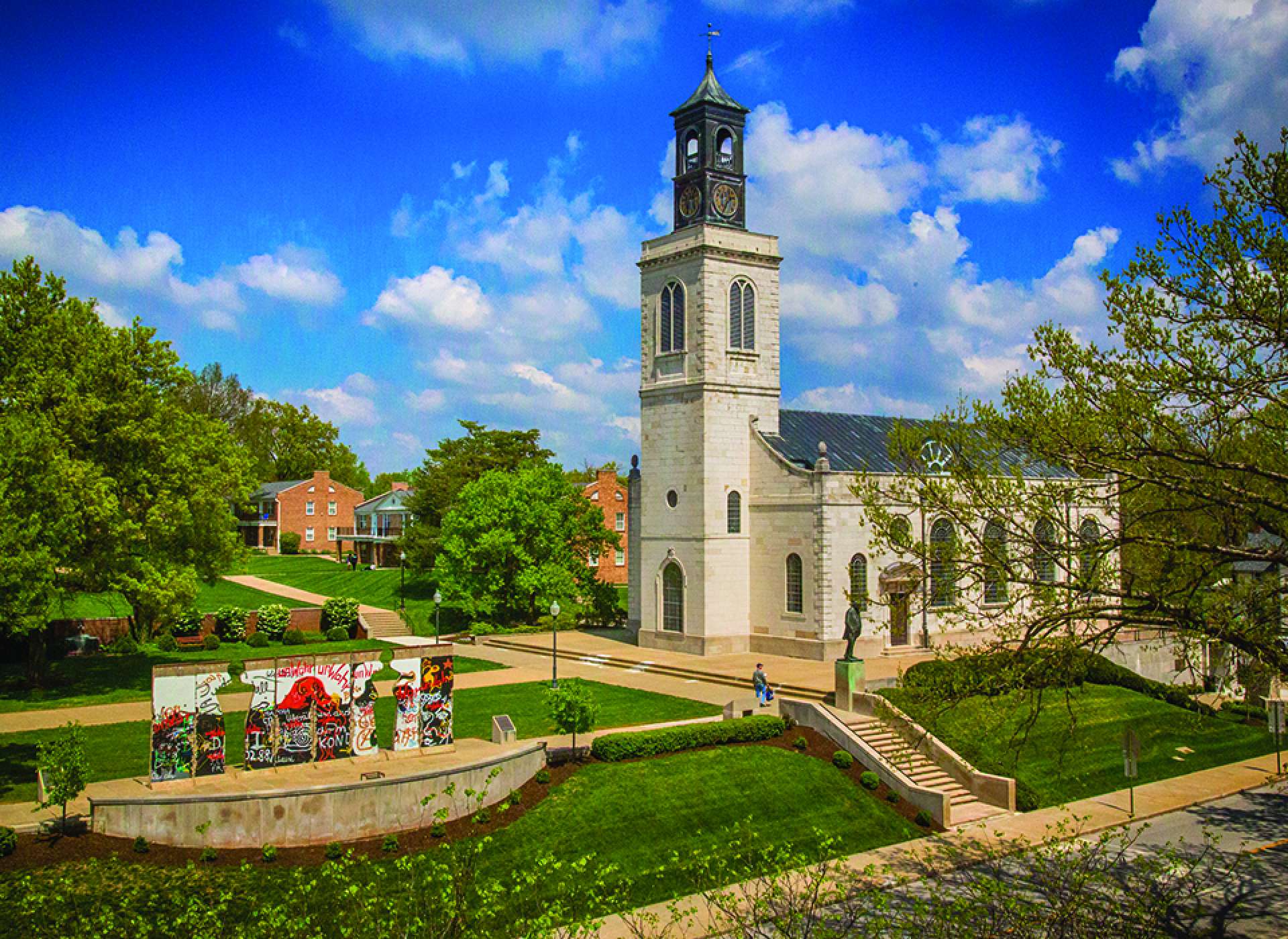
The historic Church building of St. Mary the Virgin, Aldermanbury, originally located in London. The church was moved to the Westminster College campus in the mid-1960s. Image courtesy of America's National Churchill Museum.
-
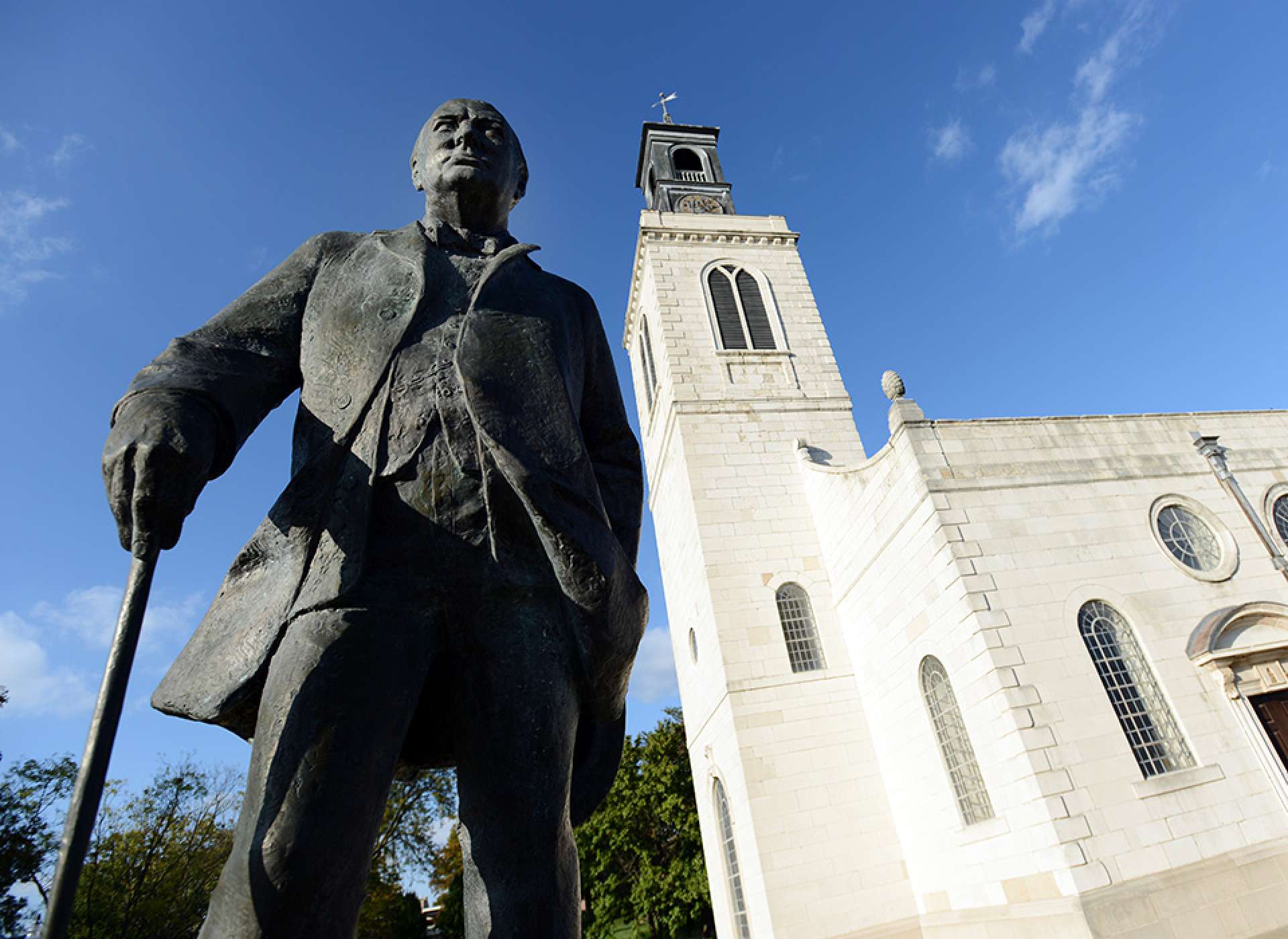
A statue of Churchill stands outside of the historic church building on the Westminster College campus, domicile to America'due south National Churchill Museum. Image courtesy of America's National Churchill Museum.

"The Sinews of Peace," the championship Churchill himself gave his address, endures today every bit one of the statesman's almost pregnant speeches. Information technology non only fabricated the term "iron mantle" a household phrase, but it coined the term "special human relationship," describing indelible brotherhood between the United States and Smashing Britain. It is a speech that offered a design for the westward to ultimately wage—and win—the Cold War.
This commodity is part of a series commemorating the 75th anniversary of the cease of Globe War II made possible past the Department of Defence.

Meet the Authors
The author is Stephen Rogers, Westminster College, with input from Timothy Riley, Sandra L, and Monroe Eastward Trout, Director and Chief Curator at America's National Churchill Museum.

Great Responsibilities and New Global Power
With the rapid ascension in ability and influence after World War II, the Usa had to accept on new responsibilities, signaling the beginning of the "American era."
Acquire MORE
Explore Further
-
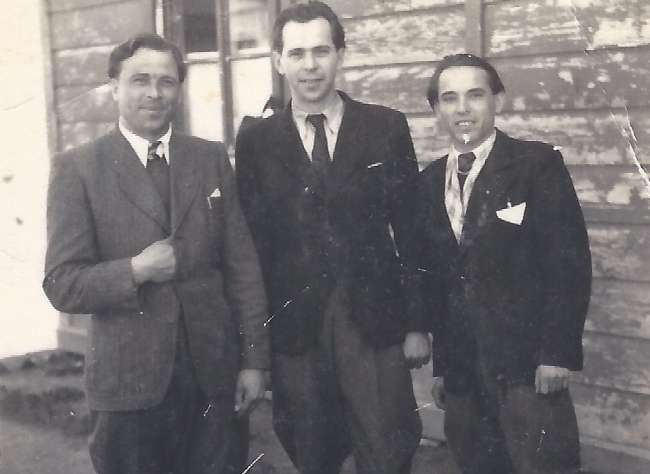
"The Last Meg:" Eastern European Displaced Persons in Postwar Federal republic of germany
After Globe War II 1.ii million Eastern European displaced persons refused to return habitation, creating a large-scale refugee crisis.
-
The Marshall Plan and Postwar Economic Recovery
The Marshall Plan was a massive commitment to European recovery after World War II that was largely supported by Americans.
-
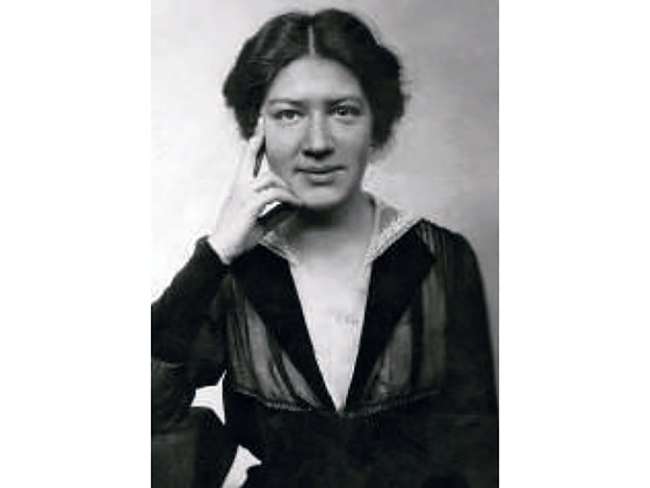
Käthe Leichter, Champion for Austria'southward Working-Class Women
Käthe Leichter (1895-1942) was a champion for working-class women in the Austrian labor movement.
-
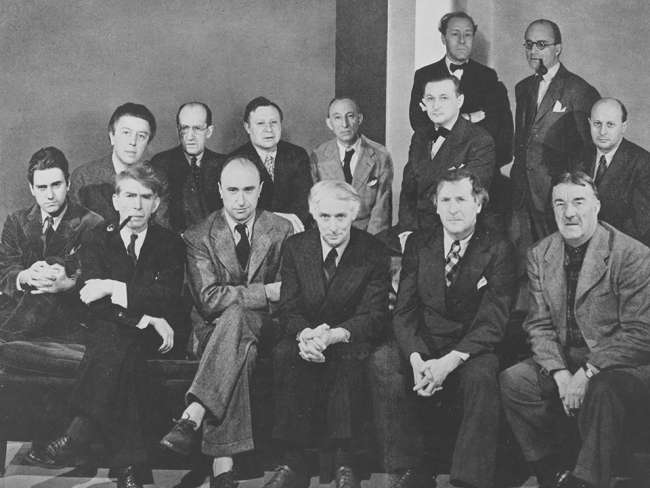
First Fruits of Exile: European Fine art at Pierre Matisse 1942
In March 1942, a special exhibit opened in New York City of 14 pieces of fine art each contributed by fourteen artists who had escaped Nazi-occupied Europe.
-
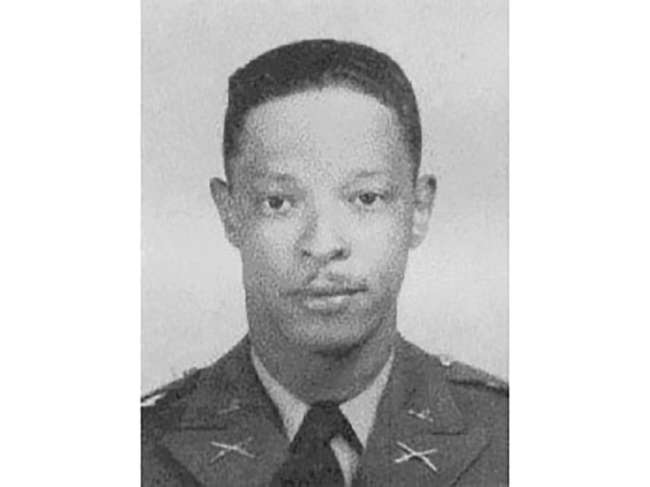
Lieutenant John Flim-flam'southward Medal of Honor
John Fox was i of seven African Americans who had their earlier awards upgraded to the Medal of Honour on January thirteen, 1997. Like all but one of the veterans, he did not live to encounter this honor.
-
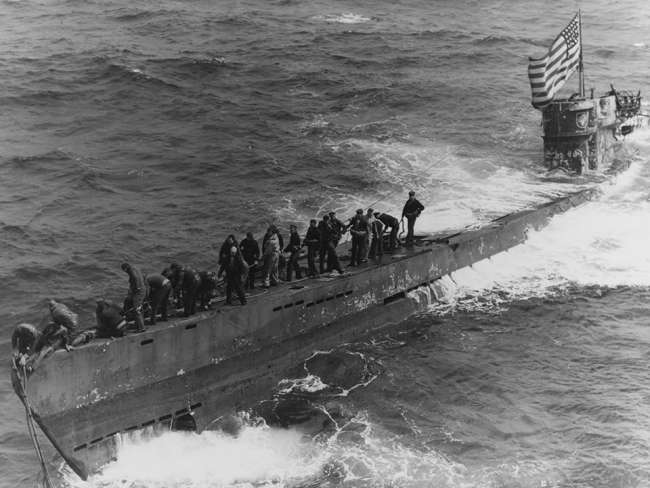
Wolf Beneath the Waves: U-505 Joins the Battle of the Atlantic
For Allied leaders, 1942 was a year of incredible danger and anxiety in the Battle of the Atlantic.
-
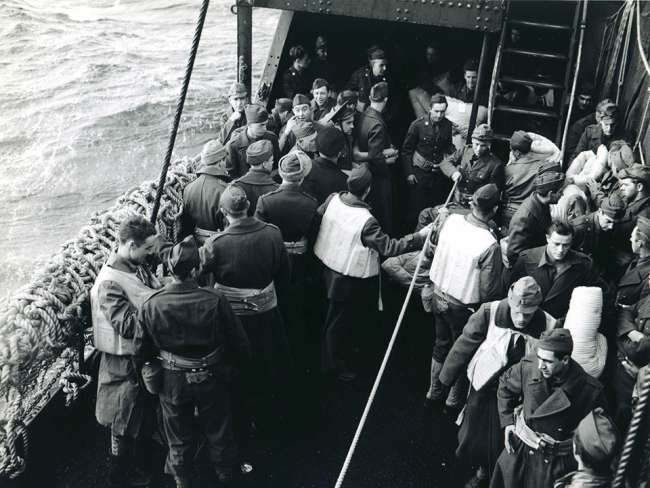
American Soldiers Arrive in the United Kingdom 1942
Soldiers of the U.s.a. Ground forces's 34th Infantry Sectionalisation, the "Red Bull" Division, landed in Belfast, Northern Ireland on January 26, 1942.
-
10 Notable World War II Books of 2021
Must-reads of 2021 picked by historians and scholars in the Institute for the Study of War and Commonwealth.


Source: https://www.nationalww2museum.org/war/articles/winston-churchills-iron-curtain-speech-march-5-1946
0 Response to "What did Winston Churchill warn the U.S. about on his visit to Fulton, MO?"
Post a Comment